
Schedule a Free Inspection
Hours of Operation
Monday-Friday 7:00 a.m. – 5:00 p.m.
Saturday 8:00 a.m. – 5:00 p.m.
Sunday Closed
Wildlife Control Near You

Best Wildlife Control in Seattle
Online Bill Pay
Birds often become a nuisance for Seattle residential and commercial properties alike.
When Do Birds Become a Nuisance?
Seeing a few birds fly through your yard or land on your roof, that’s probably nothing to be concerned about. Birds are an essential part of the ecosystem, and most species are protected by the Migratory Bird Treaty.
If you have birds that have flown into your home or are nesting or roosting on your property, they can become a serious problem that requires bird control. Flocks of birds create a hazard with their droppings, damage your roof and siding, and can rob your trees of fruit.
Starlings
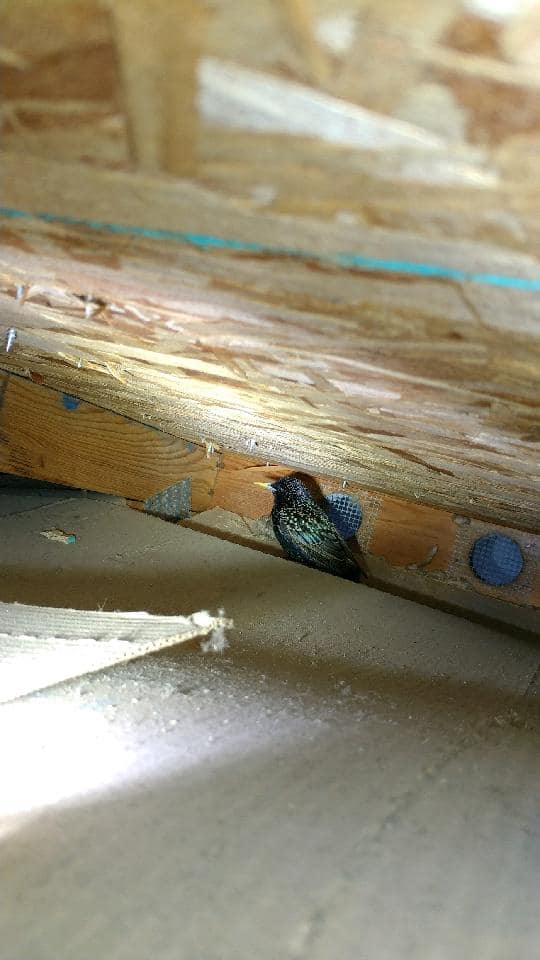
The most common bird pest that causes issues for our residential customers is starlings. Starlings have bright yellow bills in the summer with a black, iridescent spot coloring and like to nest in attics through soffit holes (bird block holes).
The birds set up nests in ornamental lawn tree cavities, holes in buildings, and any other available nook or cranny that provides suitable protection. They tend to build their nests on the outside of buildings rather than in attics, unlike many other bird species. The nests they build and use year after year, if allowed, are big, smelly, toxic, and mite-ridden.
Many products designed to prevent various bird species from nesting in residential areas are available for purchase. Mesh netting and bird spikes can be used to keep starlings from accessing favored nesting areas, while scare tactics, such as flashing lights and loud noises, frighten the birds away from the area.
Starlings become aggressive when they feel threatened, and approaching them is unnecessarily dangerous
Northern Flicker Woodpeckers
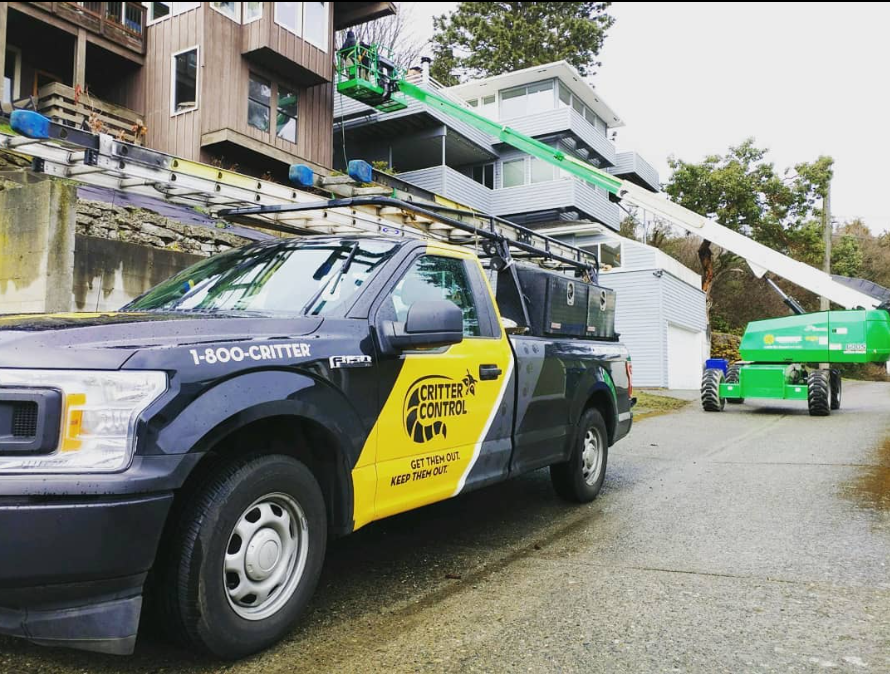
Northern Flicker Woodpeckers, indigenous to the Pacific Northwest and protected, cause the most structural damage to homes if measures are not taken early to deter them. In addition to making frequent loud, obnoxious noises, woodpeckers cause structural damage to the sides of buildings, eaves, and trim boards. The size of holes will vary depending on whether the birds are looking for food or constructing nests. Additionally, woodpecker activity leaves trees susceptible to pest insects, infection and disease, and even death.
Bird netting is frequently used to prevent woodpeckers from damaging surrounding trees and buildings. Frightening devices also provide some protection. Such methods involve the use of shiny, bright, and mobile objects near potential drilling sites. Exclusion can be difficult if the birds are well established in the area, at which point pest control professionals may be the only solution.
Swallows
Species of swallows normally live near water and are notorious for using buildings as nests. Some species nest in chimneys, while others, like the barn swallow, enjoy utilizing more roof space. Swallows create mud-saliva cup nests at higher areas along the soffit and do acrobatic dive bomb flights around their nests to protect their eggs or hatchlings.
Problems typically stem from the swallow’s proclivity to form large groups called colonies. Cars and farm equipment are often damaged by swallow droppings, and farmers also report significant livestock feed losses when the birds form large colonies nearby. The birds do not typically physically threaten humans, though mothers will swoop to stave off predators that get too close to their offspring.
Chimney Swifts
Chimney (Vaux) Swifts like to nest inside a chimney because they do not need any horizontal lift in order to achieve flight. Their nest is cup-shaped, and they can be seen swooping over the tall chimney at dusk. They migrate to South America during the fall months where they stay until the spring migration back to the Pacific Northwest.
Crows
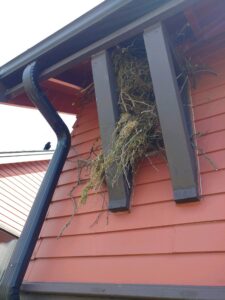
Crows are mostly found outdoors rather than in homes. Crows are common in suburban and urban areas, so they are regularly seen in Seattle neighborhoods. Crows, like many birds, thrive in human-inhabited areas because their preferred food sources can often be found in gardens, trash cans, public garbage dumps, and, in the case of carrion, along roadsides. Crows will also invade yards and parks to roost in trees.
The majority of damage caused by crows takes the form of property damage. The main reason they are considered pests to Seattle homeowners is their persistence. So what do crows eat? Foraging activity is harmful to seedlings and ripening crops. Big crow flocks can also cause damage to trees and other sites when they look for a place to roost. In addition, their loud noises create upsetting noise pollution, and their droppings produce unpleasant odors and can even facilitate the spread of diseases like histoplasmosis.
Pigeons
Pigeons are abundant and look for roosting and nesting spots that resemble the rocks and cliff ledges. Pigeons are active all day, but even more so in the early mornings when they search for bugs, insects, flowers, grains, animal waste, and human food.
Their droppings are abundant wherever infestations are present and stain building facades, park benches, statues, and cars. In addition to being aesthetically displeasing, pigeon droppings accelerate the deterioration of building materials and are malodorous. Furthermore, their excrement contains pathogens of numerous diseases, including ornithosis, encephalitis, toxoplasmosis, and food poisoning. The birds can also harbor fleas, lice, mites, and ticks in their feathers and consume and contaminate food intended for human and livestock consumption.
As pigeons spread a number of diseases, individuals are safer not approaching them. In areas where pigeon infestations threaten the general public’s health and well-being, pest control professionals should be called in to handle the problem. The trained technicians at Critter Control have the tools and knowledge of pigeon behavior to effectively and safely remove the birds.
Did You Know?
How to Keep Pigeons Away
- Restrict outdoor feedings
- Seal garbage cans at home
- Trim trees & shrubs
Gulls
Unlike smaller bird relatives, gulls usually stick to causing trouble outdoors. They will not hesitate to land in yards or other public areas in which they find food. Gulls that are comfortable with humans can even be so confident as to steal food from people eating outside, a behavior for which seagulls are infamous.
Gulls occasionally nest on chimneys or rooftops, and when this happens, they can clog drains, damage air filters, and cause corrosion of metal equipment and paint with their hazardous feces and urine. Nesting gulls are also notorious for dive-bombing pets and humans. Some hazards posed by the birds include diseases such as Campylobacter, Cryptosporidium, Giardia, E. coli, and Salmonella.
Sparrows
Sparrows are extremely common around homes and yards. House sparrows in particular share a strong bond with humans and rely on them for everything from nesting sites to food. They like to nest in secluded places, such as roof eaves or unoccupied outbuildings, while song sparrows tend to remain inconspicuous, living in gardens or bushes.
House sparrows are aggressive birds that harass and attack other native species, destroying their eggs and driving them away from food sources like bird feeders. Flocks of sparrows wreak havoc on home gardens and grain crops, as well as livestock feed and grass seeds. Their nesting habits cause further damage by blocking drains and ventilation ducts. House sparrow nests located in streetlights, on store signs, or under roof overhangs can become fire hazards.
The most effective way to discourage house sparrows and song sparrows from taking up residence in unwanted areas is to remove potential nesting sites and food sources. Property owners should do things like eliminate birdfeeders, take care not to lay down unprotected grass seeds, seal or block crevices, holes in signs, unsecured lamp posts, and overhangs with wire mesh or cloth, cut back overgrown shrubbery, and mow thickets of grass.
Though they are known to coexist peacefully with humans, sparrows are wild animals. As such, people should not attempt to approach or trap the birds. Critter Control wildlife experts are prepared to help manage unwanted sparrow problems in effective and humane manners.
What’s the Best Way to Keep Birds Away?
Several options are available to mitigate bird issues. For residential structures, the focus is more on exclusion and prevention. The most popular items are to seal off the entry and roosting points while installing intimidation and deterrent products. Just like with people, birds have their own personalities and tolerances. Some are more persistent than others and some scare easily. Deterrents include scare devices such as balloons, spikes, flashers, or mylar strips, and exclusion work has proven to be a great way to resolve the issue cost-effectively.
For commercial locations where buildings can be large, we may suggest different options due to the higher concentration of birds. In these cases, we may resort to installing netting, bird spikes, or optical gel. In particular, with pigeons, we can provide trapping services to remove the current population on the property and then install devices to prevent future incursion. Devices emit a non-toxic irritant into the air periodically so that, when birds fly around the area and inhale the solution, it discourages them from staying there.
Here are a few product descriptions of things that are commonly used for bird control:
Bird Netting
Birds have the ability to get into gaps that are as small as 3/4 of an inch (depending on the bird species), so specialized netting material is needed to provide adequate protection from bird entry. Nets come at various gap sizes, lengths and heights. They range from 10ft x 10ft, 25ft x 25ft, 50ft x 100ft and possibly some custom sizes; however, usually, the netting may have to attached together if it is not the adequate size. Bird netting can be used alongside buildings and to enclose areas off completely. They can be ordered in different colors. Manufacturer provides a 5-year warranty on the product.
Bird Repellent
The most common repellent is a taste or visual deterrent. Woodpeckers, for example, lick the surface of the area they are drilling (pecking) into to create holes or claim their territory. Repellents can be sprayed onto the surface of the area that they are drilling to make the surface taste bad, thus creating an undesirable location to be in. Other birds, such as pigeons or doves, congregate in large numbers. They can be a nuisance in high traffic areas such as department and grocery stores as these areas provide a high place to roost and (usually) ample food access. An avian repellent, used in our Bird Buffer machine, is a natural irritant that attacks the lungs and eyes of the birds flying into the mist the machine creates using the fluid. This repsonse is temporary but, if used consistently and correctly, can cause long-term bird problems to disappear.
Bird Slide
Bird Slide is a permanent deterrent system for birds such as pigeons that like to nest or loaf on ledges of buildings. They are installed via screws or glue and are paintable to match the structure. They are highly effective in creating a ledge that discourages them from landing.
Bird Spikes
Bird spikes are the most common form of eliminating roosting access for birds. They work for birds as small as finches to as large as seagulls. They come in sizes of 1 inch, 3 inch, 5 inch and 8 inch spread to provide the best coverage. They can be easily cut and installed onto almost any surface. They can be glued or screwed down. The spikes are made out of stainless steel, which provides longer lifespan and a plastic base. It is best to have the application area cleaned off for the best installation.
Daddi Long Legs
The daddi long legs is a bird deterrent product. It is best for covering a larger surface area that is not a ledge situation, such as a roof or ventilation system. The daddi long legs comes in different circumference sizes (4ft, 6ft to 8ft) for the best coverage. The legs are not in a fixed position. Thin, stainless steel rods rotate in the breeze and wave menacingly, interfering with birds’ wings as they attempt to land. It is flexible, so that if a bird tries to land on it, it makes it an undesirable landing area. Birds tend to land on sturdy surfaces, thus the legs take that away. It is best to have the application area cleaned off prior to installation.
Decomesh
Decomesh is a permanent exclusion material to repair or replace soffit screening that is aesthetically pleasing. It comes in both white and brown with varying widths. It is a great alternative besides hardware cloth to exclude birds and squirrels.
Van Vent Covers
A fan vent cover is made of sturdy plastic material that helps prevent access for birds and rodents from an exterior vent hole. The product can be painted to match the house color. The customer is responsible for their own maintenance with their ducts. The cover is able to be removed and put back in place to allow the customer to clean out the vents.
Flex Track
Flex Track is a shock track system that can be used in multiple situations. The product can be used against birds, raccoons, and otters just to name a few. The shock track runs on a power supply that sends intermittent power surges throughout the track. If an animal is on the track, it will feel a shock and deter landing or usage of the area(s) being protected by the track. Birds get shocked by landing on the track. Raccoons can get shocked on their paws when trying to access a roof from a tree or fence. An otter can encounter a shock when it lifts itself out of the water and onto a dock. It is a humane method of eliminating access for animals, such as an electric fence works for livestock. It comes in grey, black or tan color to try to match the area it would be installed. It is best to have the application area cleaned off for the best installation.
Mylar/Flashes
Mylar tape strips are a visual deterrent against woodpeckers and other birds. It is hung on a structure to intimidate a woodpecker and other birds from landing or flying around a certain area of a structure. This can also be hung on scare eye balloons for increased intimidation. Flashers are objects that have any reflexivity to it that would intimidate a bird, in particular, woodpeckers.
Optical Gel
Bird Barrier optical gel may be used to deter feral pigeons, gulls, and many other unwanted birds from roosting on buildings and other structures. It does so by altering their behavior, not by acting as a physical barrier. Once applied, birds will completely desert a habitat, even one they have been using for years. Multi-sensory bird repellent that has birds seeing fire or smoke, although there is not any and smelling peppermint oil, which they dislike. It also is sticky to the touch, which birds to not like to land on. Bird Barrier optical gel is supplied in ready-to-use plastic-dish containers. These should be affixed to surfaces with commercially available silicone adhesive or other suitable and removable adhesive.
Scare Eye Balloons
Scare-eye balloons are highly effective against woodpeckers. They are visual deterrents that mimic a predator’s eye to intimidate a woodpecker from the area. The balloons also come with flasher attachments to add additional intimidation effects. They usually come as mylar streamers and reflective stickers to attach to the balloon. When attached to a pulley system, the balloon will have the ability to move up and down with a slight breeze to add additional intimidation because it is not always in a stationary position. It would be the home owner’s responsibility to provide maintenance to the balloon or remove it if they did not want it up any more. We could provide that service at an additional cost to remove, reinstall or adjust the position of the balloon.