
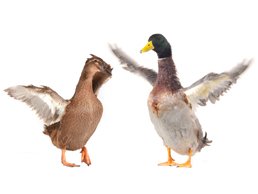
Ducks are common throughout the world, with natural habitats ranging from arctic to tropical. Aquatic birds, ducks live near fresh or sea water where they mostly eat plants, insects, and small amphibians. Dabblers, such as mallards, feed on food found near the surface of the water or on land. Diving ducks submerge themselves in water to get at aquatic plants and catch fish. Across North America, ducks are commonly hunted and farmed for their meat, eggs, and downy feathers.

Find Service in your Area:

Get them out.
Keep them out.®

Experiencing a wildlife or pest issue? We can help! Complete this form and your local Critter Control® office will contact you to assist.

Posted on Google Google
Tracey Schurtz profile picture
Tracey Schurtz
9 October 2026
Google star 1Google star 2Google star 3Google star 4Google star 5Trustindex verifies that the original source of the review is Google.
Bob, the service tech, is friendly and always communicates what he is doing, activity, refill stations etc. He also arrives within the scheduled time frame.
Posted on Google Google
Jill Mccrackin profile picture
Jill Mccrackin
9 October 2026
Google star 1Google star 2Google star 3Google star 4Google star 5Trustindex verifies that the original source of the review is Google.
Bryan came out to give me a quote , he is very professional and started the job that same day .. The total job was complete in the same week He and his team kept we well informed .. Would use again
Posted on Google Google
DMP profile picture
DMP
9 October 2026
Google star 1Google star 2Google star 3Google star 4Google star 5Trustindex verifies that the original source of the review is Google.
Critter control has been taking care of our woodpecker problem for a few years now-well worth it. Especially compared to the damage we have incurred. Our new tech Ben is local and couldn’t be better. Just had the place sprayed for stink bugs and those lousy look alike lady bugs. Contact these guys before you go with any one else. For years we had the place sprayed for stink bugs with another company and all they did was spray a few feet up. Ben got way up to the second story soffits. Thanks.
Posted on Google Google
Annette Hagemann profile picture
Annette Hagemann
9 October 2026
Google star 1Google star 2Google star 3Google star 4Google star 5Trustindex verifies that the original source of the review is Google.
Cherina was great and she returns to me every month. Services are done well and to my satisfaction. Highly recommend the Company!
Posted on Google Google
p patel profile picture
p patel
8 October 2026
Google star 1Google star 2Google star 3Google star 4Google star 5Trustindex verifies that the original source of the review is Google.
Anthony did fantastic job. Very professonal and answer all of my questions. Thank you Anthony.
Posted on Google Google
Patrick Toney profile picture
Patrick Toney
8 October 2026
Google star 1Google star 2Google star 3Google star 4Google star 5Trustindex verifies that the original source of the review is Google.
Everything went as advertised from the first visit dealing with bats in the walls. Every person that came to do the necessary work was professional and the removal of bats was smooth. Also, the workers were prompt to answer any questions and seemed very knowledgeable. I recommend using Critter Control. Patrick Toney
Posted on Google Google
Nancy Tyler profile picture
Nancy Tyler
8 October 2026
Google star 1Google star 2Google star 3Google star 4Google star 5Trustindex verifies that the original source of the review is Google.
When we had a critter issue in our attic Brian and his team were amazing and completely professional. I cannot recommend them enough. Their communication, expertise and attention to every detail is so impressive! We are now critter free!
Posted on Google Google
Chris p profile picture
Chris p
8 October 2026
Google star 1Google star 2Google star 3Google star 4Google star 5Trustindex verifies that the original source of the review is Google.
Adam came to my house and solved my problem. Took care of my pest problem for good! Answered all my questions and would recommend to anyone.
Posted on Google Google
Aaron West profile picture
Aaron West
8 October 2026
Google star 1Google star 2Google star 3Google star 4Google star 5Trustindex verifies that the original source of the review is Google.
Danny&Luke came out to retrieve a dead animal under our crawl space , they didn't give up, searching and searching until they found it, a very stinking opossum, thank you for your commitment!!! Very nice people!
Posted on Google Google
Annette Roden profile picture
Annette Roden
8 October 2026
Google star 1Google star 2Google star 3Google star 4Google star 5Trustindex verifies that the original source of the review is Google.
So grateful for their help. They were quick to respond, helpful and professional!

There are many types of ducks with varied colorations and patterns on their plumage. One of the most common species of duck found in the United States is the mallard. Male mallards, known as drakes, have glossy green heads, broad yellow bills, and white feathers on their wings and bellies. Female mallards, known as hens, are speckled brown and white. Baby ducks are fuzzy and yellow, and follow the mother wherever she goes. In Texas and Florida, Muscovy ducks, native to Mexico and South America, have black and white feathers over their bodies, pink or black beaks, and red wattles.

Mallards and other similar North America duck species typically live near wetlands but can nest wherever suitable sources of fresh water are found, such as lakes, ponds, or gently running rivers. Ducks also like spaces with large, open fields and plenty of grass to eat. Nesting sites are often situated near the water and are protected by the mother ducks.

Are ducks known to enter homes or yards?
Wild ducks do not enter houses because they prefer open spaces where they can swim or fly away if startled. However, some ducks are kept as pets. Wild ducks may enter yards while searching for tender grass or vegetation to eat. Additionally, setting out food for the birds entices them to come by regularly.

Do ducks harm people or property?
While ducks do not attack people, they tend to gather in flocks, and the damage they do to property may be considerable. Yards, fields, public parks, ponds, and water reservoirs become damaged by massive amounts of duck feces. The droppings make open spaces, ponds, and sporting fields unpleasant or unsuitable to human use. More serious problems arise when droppings contaminate ponds and other water sources.

Flocks of ducks also create safety issues at airports and roadways by blocking traffic. Mallards are known to transmit diseases, such as duck plague and fowl cholera, to other waterfowl, which makes them a danger to other native populations of birds and livestock

The Migratory Bird Treaty Act protects mallards and most other species of migratory ducks in the United States from being killed or removed during most of the year. One of the best forms of population control is state and federally regulated hunting seasons. Furthermore, frightening the birds away is an effective means of nonlethal control. Using scarecrows and balloons or spraying the birds with hoses will disturb them and cause them to leave. The simplest way to discourage ducks from coming onto property is to eliminate food sources by discontinuing feeding and allowing grass to grow longer, making access to edible shoots more of a challenge.

Trapping, killing, and removing mallards is prohibited outside of designated hunting seasons, and tampering with nests, harming ducks, or releasing live-caught specimens are all considered federal offences. As such, infestations of ducks should be dealt with by wildlife specialists. Call the technicians at Critter Control to safely, humanely, and legally remove duck populations.

Call for an Estimate Today!

Duck Quicklinks